Running a shop means you probably know your regulars by name. But knowing who walks through the door isn't the same as getting them to return. You need to bring those regulars back.
This article explains a retail loyalty programme that runs smoothly, gets repeat purchases, and costs nothing to start.
Key Takeaways
- A retail loyalty programme works best when local customers can join in seconds at the checkout.
- Digital-first setups eliminate the cost of printing and tracking plastic cards.
- Simple reward structures ensure shoppers see immediate value and stay engaged.
- Email marketing delivers the most cost-effective return for reaching a tight-knit database of 400 loyal locals.
- Clear programme rules protect your profit margins by removing the need for desperate, shop-wide blanket discounts.
What Is a Retail Loyalty Programme?
A retail loyalty programme is a customer retention tool that rewards repeat customers with points, store credit, or perks, encouraging continued spending. For example, a shop might give a $10 voucher after a customer spends $200.
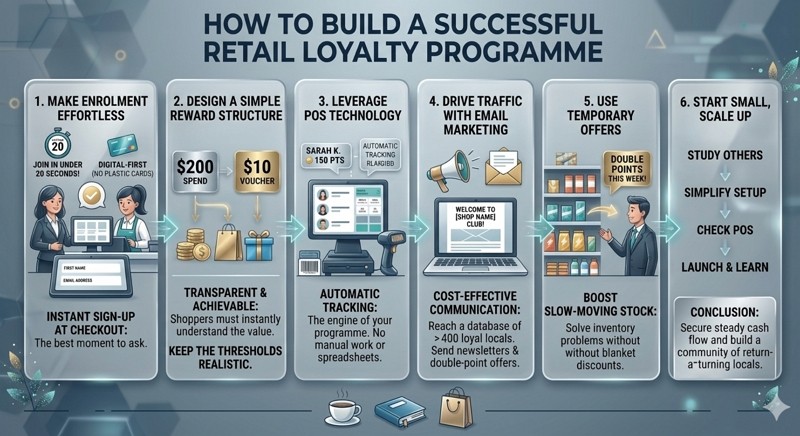
Joining should be fast. Aim for under twenty seconds — ask only for a first name and email address. Skip the home address, skip the date of birth. Every extra field is a reason for someone to walk away.
You don't need thousands of members to make this work. I've seen suburban shops with just 300 to 400 active loyalty members comfortably sustain a programme. A shop with 400 members who visit four times a year generates the stable, predictable revenue that makes independent retail viable.
Done right, a loyalty programme will:
- Increase your average basket size — shoppers spend more when they know points are accumulating.
- Drive repeat visits without relying on expensive traditional advertising.
- Give you a concrete reason to contact your community. Instead of waiting behind the counter hoping people walk in, you can actively invite them back. A lotto shop, for instance, can message its VIPs ahead of a superdraw and capture the syndicate spend.
How to Make Loyalty Enrolment Effortless at Checkout
Enrolment is everything. The checkout counter is the single best place to ask someone to join — they've already opened their wallet, and they trust you enough to complete the purchase. A cashier asks:
"Would you like to earn points on this purchase today by joining our VIP club?"
Keep the sign-up to the absolute minimum. First name and email address are enough to get started. A mobile number is a useful backup — customers often forget which email they used, but they always know their phone number.
A digital loyalty system has one killer advantage over physical cards: your customers can never accidentally leave their rewards at home.
What Reward Structure Works Best for a Small Shop?
The best reward structure is transparent. Customers must be able to instantly understand what they get and how quickly they can reach it. If the rules feel vague or the thresholds seem impossible, members will lose interest — and worse, they may feel you're being dishonest.
Keep the thresholds achievable. If the first reward feels completely out of reach, most members will forget they ever signed up.
How Email Marketing Drives Your Loyalty Programme
Email is the most cost-effective way for retailers today to communicate with their customers. It can drive immediate foot traffic. Unlike paid ads or unpredictable Facebook campaigns, sending an email to a database of, say, 400 people costs zero to next to nothing depending on your email service. A local shop can email its entire loyalty list about a new product line in seconds.
We've tested several email platforms for SMB retailers. Our current pick is EmailOctopus; its free plan covers up to 2,500 subscribers and is more than enough to get started. You can always upgrade later once you've learned the ropes and you feel that you need better. Another good choice is BlueFox Email.
How a POS System Manages Your Loyalty Programme
A POS system is the engine of your loyalty programme. It tracks every customer, sale, and point balance automatically — no spreadsheets, no drawer full of stamped paper cards. When a regular buys their weekly coffee beans, the POS adds points to their profile the moment the receipt prints.
A good POS gives you:
- Instant reporting on who your most valuable VIP shoppers are.
- Automatic rule enforcement — the software handles expiries, returns, and redemptions without manual work. If a customer returns a faulty kettle, the POS deducts the loyalty points they originally earned, keeping the programme perfectly balanced.
What Should You Do Next? A Step-by-Step Action Plan
- Study what's already working. Look up similar businesses to yours on Facebook. Follow their history — you'll see what campaigns they've run over time. Chances are you're already a member of a few loyalty programmes yourself. Strike up a conversation with the owners: "Tell me, do people use it? I'm thinking of setting one up — how does it go for you?"
- Simplify your current setup. Strip away unnecessary complications. The simpler your programme, the better it will perform. Aggressively cut any step that doesn't absolutely need to be there. Start small — you can always improve it later.
- Check your POS technology. Confirm that your existing retail POS can handle loyalty tracking. If it can't, factor that into your decision before you launch.
- Launch with a welcome email. Use the template below as your starting point:
Subject: Welcome to [Your Shop Name] Club — Here's Your First Reward!

Hi [Customer Name],

Thank you for joining our loyalty programme and supporting a local shop. We love seeing familiar faces, so we want to make your next visit extra special.

Here's 10% off your next purchase — a proper thank you for shopping locally.

Earning rewards with us is simple:
→ Earn 1 point for every dollar you spend.
→ We'll automatically send you a $10 voucher every time you hit 200 points.
→ No manual work, as our POS system tracks everything.

Just show this email or give us your name next time you pop in.

We look forward to seeing you again soon.

Warm regards,
[Your Name]
[Your Shop Name]
Email Frequency
Send one email every other month. Don't overdo it — your reason to reach out should always be genuine. Too many messages and people will unsubscribe or block you. In a future post, I will go over some successful retailers' email newsletters.
Conclusion
A retail loyalty programme is the single best tool a small shop has to secure steady cash flow and build a community of returning locals. Keep the rules simple. Go digital-first. Make enrolment effortless. Your customers — and your bottom line — will thank you.
Start small, learn fast, and let your regulars do the rest.
Written by:

Bernard Zimmermann is the founding director of POS Solutions, a leading point-of-sale system company with 45 years of industry experience, now retired and seeking new opportunities. He consults with various organisations, from small businesses to large retailers and government institutions. Bernard is passionate about helping companies optimise their operations through innovative POS technology and enabling seamless customer experiences through effective software solutions.