

In retail today, we need to make heaps of pricing decisions every week, and discounting is one of the hardest to get right. A well-timed markdown can save a sale, but what is less visible is how repeated, uncontrolled discounting drains profit. Often, worse, it can devalue your shop.
Key Takeaways
- Excessive discounting reduces prices.
- Strategic discounting supports a clear goal.
- A 10% discount on a product with 40% gross margin requires a 33.3% increase in unit sales to recover the lost gross profit.
- Stacked discounts are dangerous because multiple offers on one sale can remove much of the profit.
- The Discounted Items Sales Summary report in your POS system is great at revealing markdown patterns.
- Repeated markdowns in one category or supplier can point to a buying problem.
- Clear discount approval policy controls support better retail price management.
Excessive Discounting
The problem is not generally the discounting itself. Often, we need markdowns to clear aged stock or rescue a sale. For example, a Christmas item often needs an emergency clearance while it is still marketable.
Excessive discounting often begins when these markdowns become a habit. For example, if your staff automatically gives 10% off when a customer asks.
Excessive Discounting Matters
Excessive discounting matters because every markdown comes straight off your profit.
Discounting can create an illusion of improvement in the shop by increasing sales.
From personal experience, I can tell you that heavy discounting will train your customers to treat your prices as negotiable.
How Much More must be Sold to Cover a Discount?
It is surprising how even a small price cut can remove a larger share of the profit on that item.
An item with a 10% price discount that costs $11.00 and has a retail price of $18.00 reduces your gross profit by 25.7%, from $7.00 to $5.20.
Info: You make the same profit by selling 100 units at full price as 135 units at this discounted price
Here is the table for this sample item showing the price margin drop and break-even requirements.
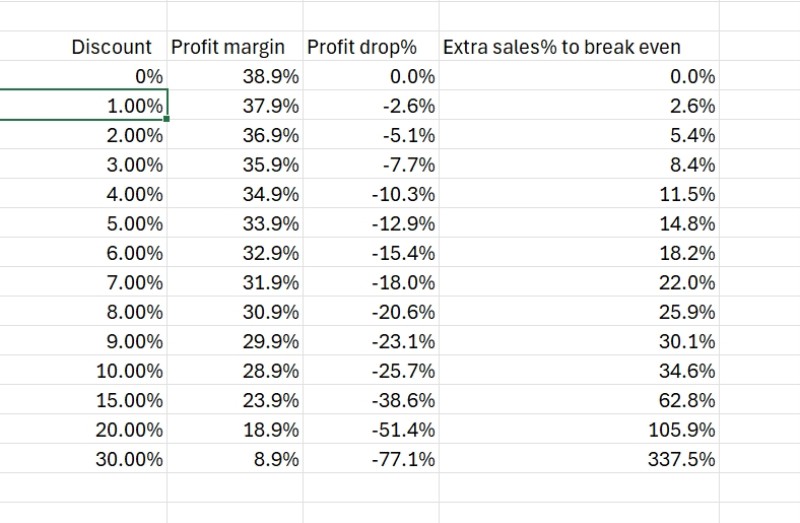
Moreover, retailers often want the quick break-even version by margin. With a 40% gross margin:
- A 5% discount needs 14.3% more sales.
- A 10% discount needs 33.3% more sales.
- A 15% discount needs 60.0% more sales to recover the lost profit.
That is why "just take 10% off" is rarely a small decision.
Stacked Discounts
Stacked discounts are two or more discounts on the same item. It dramatically increases the discount.
Info: A typical example would be a clearance markdown and a loyalty reward.
What Happens When Customers Expect a Discount?
Customers learn from repeated pricing behaviour. If your shop discounts too often, many shoppers start to see full-price items as something to negotiate or wait out. It devalues the shop too.
For example, if customers know your lifestyle range is always discounted at the end of the month, many will delay the purchase. That makes it harder to sell on value.
How Do You Control Discounting in a Retail Store?
Staff discounting needs clear rules.
You should have a discount approval policy in your shop. It needs to specify who can discount and by how much.
Most shops say that only a manager can approve a discount, and ban all discounting on certain products.
Your POS system should enforce that policy. Make sure that it is also set to activate an audit trail to log every discount.
Discounted Items Sales Summary Report
In our POS System, there is a Discounted Items Sales Summary report that shows discounted sales activity to help you identify your discount patterns. This is evidence that is much better than relying on gut feeling.
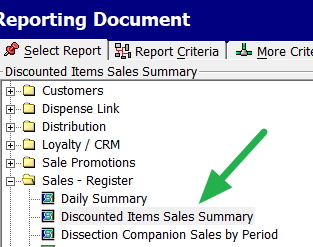
In the reports,> Go to Discounted Items Sales Summary
It is shown below, marked with a green arrow.
Fill in the appropriate responses, and here is the basic report that appears.
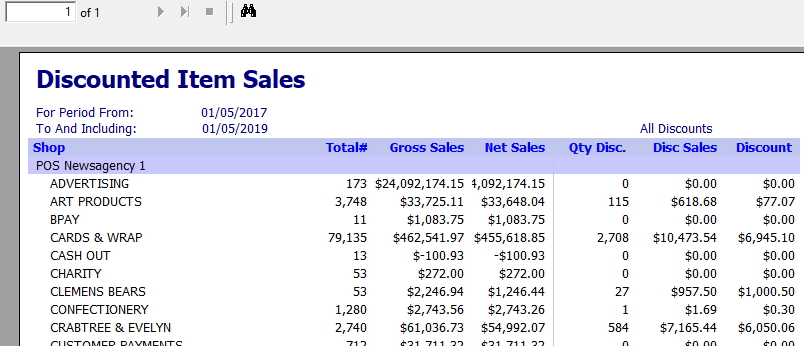
What it shows is sales and, most importantly for this question, the discounting by product type.
Note the large discount that had to be given to the Clemens Bears here to sell them.
Using the Discounted Items Sales Summary Report
Treat it as part of regular management reporting.
Run the report over a date range, I suggest once a month. What you need to do is look for reasons why products are being discounted. Generally, a discount shows something is wrong.
Excessive Discounting Affects Cards, Stationery, and Giftware
The first question to ask yourself is does a product need a discount?
A greeting card's sales are often made on a need basis.
Info: A shopper who needs a sympathy card today usually buys one, even if the price isn't discounted.
Stationery needs a more selective markdown strategy. Invoice books, for example, are often purchased when someone needs them now.
Giftware is often a problem item; it's so hard to know what will work and what won't. A plush gift line, all too often, looks exciting at a trade fair but struggles in-store. Sometimes we have to be ruthless.
Frequently Asked Questions About Excessive Discounting
Q: Which products or suppliers are actually causing the problem?
A: Look for repeat markdowns by item, department, and supplier in the Discounted Items Sales Summary report. When one supplier range keeps appearing with high discount values, that often points to a buying issue rather than a pricing issue.
Q: How often should I check discounting in the POS?
A: Check it routinely. A weekly review suits many independent retailers. I suggest a monthly review, which gives you the range to spot patterns.
Q: Do I match a competitor's price or hold firm?
A: Treat that as a margin decision first. Check whether the lower price still leaves enough profit and whether the likely sales gain actually justifies the cut. See if you can make a value-based response.
Q: How do I stop customers waiting for the next sale?
A: Be less predictable. If your markdown pattern becomes too predictable, customers are more likely to delay buying.
Next Steps
The goal is not to stop all discounting. The goal is to use markdowns intentionally so they support sell-through, protect gross profit, and strengthen retail price management.
The next step is to turn discounting into a managed process. Review your current practices, enforce staff permissions, and use your POS System.
Then identify the main problem areas, e.g., items, suppliers, or staff.
Written by:

Bernard Zimmermann is the founding director of POS Solutions, a leading point-of-sale system company with 45 years of industry experience, now retired and seeking new opportunities. He consults with various organisations, from small businesses to large retailers and government institutions. Bernard is passionate about helping companies optimise their operations through innovative POS technology and enabling seamless customer experiences