
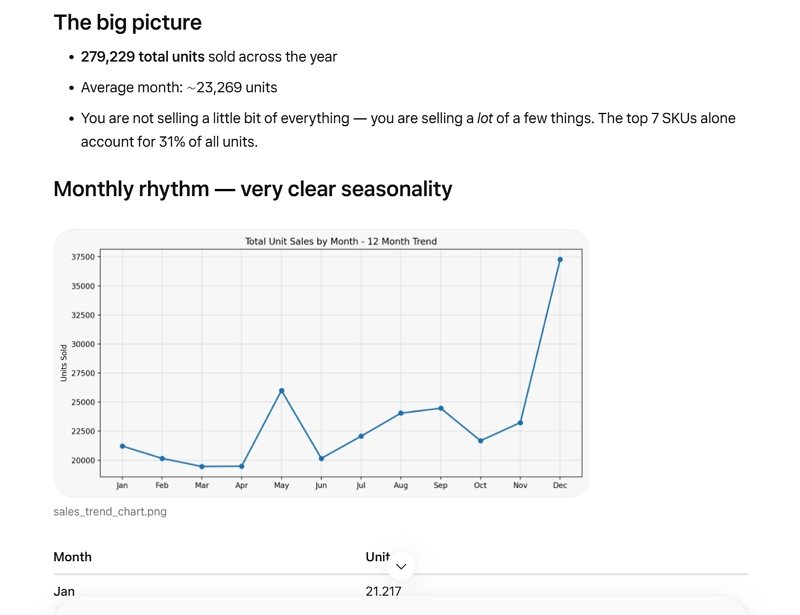
We all rely on the Point of Sale (POS) system for essential ordering, staffing, and seasonal planning. Part of what we are looking for in AI is advice that may lead to ideas of what to do next, missed stock opportunities and hidden risks. What we did was benchmark several commonly used free and paid AI to see how they performed for such use. The results quite stunned us.
What Are POS System Reports Reviewed By AI?
We decided to print a sales report from our POS system and asked for an AI review. We use several newsagencies and have a sales report listing over 2 years' worth of about 100,000 items that have sold. A shop selling $500,000 a year at an average unit price of $10 per item sells 50,000 items; this is hardly what one would call a big shop. In retail, you need about 2 years of seasonal figures to compare, say, Feb this year with Feb last year. Doing that requires a lot of data; it's not just the items, but also sales quantities, prices paid, discounts given, GST, etc., and we discovered that many AI systems couldn't handle this workload.
Which AI Tool Reviews POS System Reports Best?
Going over the reports, it was found.
Meta AI, a free service, produced the most useful answer. It easily processed the massive amount of information, built useful monthly tables, and provided good stock recommendations. I was shocked that the free one did the best job.
Conversely, the remaining AI tools demonstrated common ways in which AI will underperform when faced with shop data. For instance, Gemini, which is so highly regarded, typically analyses about 50% of the information we supplied and then stops.
How Did Each AI Tool Perform?
Below is our breakdown of how the different AI tools handled the data loads from fairly small retail shops, from best to worst.
- Meta AI: This AI tool effortlessly handled massive data and provided free, actionable advice, making it the best option for major stock decisions despite missing complex margin analysis. Sample report, we got on the top.
- Claude: This model produced sensible category assignments, but its answers were too vague for ordering, so it is best used for spotting broad seasonal trends.
- Local AI: This AI excels in data security and privacy, but its analytical depth is average.
- Gemini: Nice formatting, looked nice, but broke down under the data load.
- ChatGPT: This famous AI tool figures were correct, but its reporting was pretty useless.
Info: The free AI meta got the best score, and number 3 was local AI, another free model. Paying did not yield better results.
Note that data security is most important to you; only local AI can do that, but that is another issue for another post.
What Are the Next Steps for Retailers?
The next steps for retailers involve starting with one specific report and running it through your chosen AI tool to test its true data capacity. For example, export your heavy monthly category performance data and explicitly ask the AI to suggest three immediate merchandising changes for the shop floor.
Always verify the totals against your original Point of Sale (POS) system export before taking any physical action. We were shocked to see how badly Gemini performed here.
Conclusion
Clearly, pairing your POS system with an AI report can provide you with better information, but you need to check the results.
Written by:

Bernard Zimmermann is the founding director of POS Solutions, a leading point-of-sale system company with 45 years of industry experience, now retired and seeking new opportunities. He consults with various organisations, from small businesses to large retailers and government institutions. Bernard is passionate about helping companies optimise their operations through innovative POS technology and enabling seamless customer experiences through effective software solutions.