
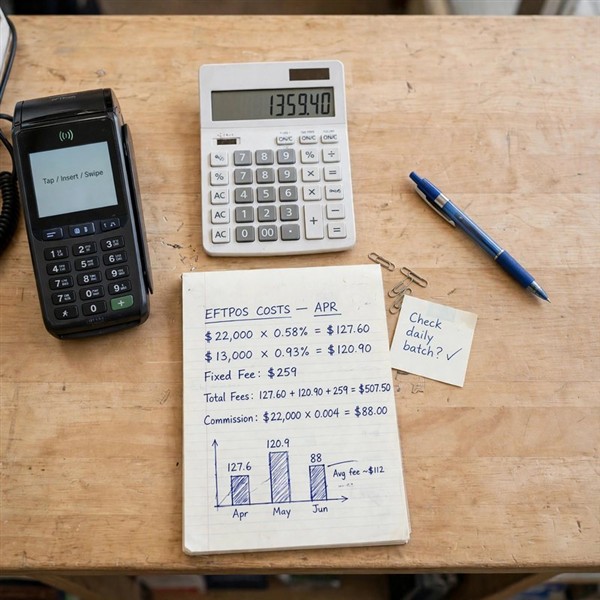
Here is a step-by-step way to calculate what you really pay each month for EFTPOS and credit cards. It takes a few minutes and uses information you already have in your POS system.
For most small businesses turning over around $1 million a year, the total cost of accepting cards is typically between 1.1% and 2.5% of card sales. It depends on your average basket size, number of transactions, the plan you are on and how good a negotiator you are.
That might not sound like much, but on $40,000 to $60,000 in monthly card sales, a difference of 1% adds up to nearly $6,000 a year. Multiply that across a group and you quickly see why this is worth checking.
What You Will Need
- Your merchant statement or rate sheet from your EFTPOS provider
- From your POS system, run a 12-month totals report: total sales value and number of transactions for each payment type — eftpos, Visa/Mastercard debit, Visa/Mastercard credit, and American Express
The Simple Formula
For each card type, calculate:
Monthly cost = (Monthly sales × percentage rate) + (Monthly transactions × fixed fee per transaction)
To get the monthly figures from your 12-month POS report:
- Monthly sales = Total sales for that card type ÷ 12
- Monthly transactions = Number of sales for that card type ÷ 12
Then work out your most important number — your effective rate:
Effective rate = (Total monthly fees ÷ Total monthly card sales) × 100
This single percentage tells you the true cost and is what you should use to check your margins.
A Worked Example: A Newsagency or Pet Shop
Imagine an average month for a suburban newsagency with a bookshop and gift section. The rates below are examples only to show the maths. Yours will depend on your provider and whether least-cost routeing is enabled.
Total card sales for the month: $45,000
| Card Type | Monthly Sales | Monthly Transactions | Example Rate | Monthly Cost |
|---|---|---|---|---|
| EFTPOS | $22,000 | 900 | 0.40% | $88.00 |
| Visa / Mastercard debit | $13,000 | 450 | 0.50% | $65.00 |
| Visa / Mastercard credit | $8,000 | 220 | 1.00% | $80.00 |
| American Express | $2,000 | 40 | 1.30% | $26.00 |
| Total | $45,000 | 1,610 | $259.00 |
For this example we have assumed no fixed per-transaction fee to start.
Effective rate = $259 ÷ $45,000 × 100 = 0.58%
This is a best-case rate, usually only possible with least-cost routeing turned on and no terminal rental included. Most businesses will see a higher number on their actual statement.
Now add a 10-cent fixed fee on every transaction, which many plans include:
- Fixed fees: 1,610 × $0.10 = $161.00
- New total: $259 + $161 = $420.00
- New effective rate: $420 ÷ $45,000 × 100 = 0.93%
That extra 0.35% comes entirely from the cents-per-transaction charge. On top of this, you may also pay a terminal rental of $30 to $80 per month, which should be but is often not included in this percentage.
Now if you look through your statements, we will see other charges that you need to add to your costs.
Use these to calculate your actual percentage.
This actual percentage tells you, for example, if an item's retail price is $10, and your actual percentage is 0.95%. It costs you $10 x 0.95% for EFTPOS to sell it.
Common Pricing Models
Providers quote costs differently. Knowing your model helps you use the formula:
1. Flat-rate or blended pricing: One percentage applies to all card types, for example, 1.1% on everything. It is simple to calculate, but you often overpay on cheaper EFTPOS and debit transactions.
2. Interchange-plus or scheme-plus pricing: You pay the actual interchange or scheme cost plus a fixed margin. This is usually cheaper at scale, but the statements can look more complex.
3. Tiered pricing: Different rates apply to "qualified", "mid-qualified" and "non-qualified" transactions. It is harder to forecast, which is why calculating your own effective rate is so important.
Whichever model you are on, your effective rate (total fees divided by total card sales) lets you compare like with like.
Putting Your Numbers to Work
Once you know your numbers, you can:
Check whether your rates are reasonable. For a sub-$1m turnover business, an effective rate of 1.1% to 2.5% is common depending on your provider and card mix.
Model changes. What if you negotiated 0.2% off your credit rate? What if you moved to a plan with a slightly higher percentage but no terminal rental? Plug the new rates into the same formula and compare.
A Quick Checklist for Your Next Statement
When your next merchant statement arrives, look for:
- Your total card turnover for the month
- The total fees charged
- A breakdown by card type, if provided
- Any fixed per-transaction fees or terminal rental charges
- The effective rate, or calculate it yourself: (total fees ÷ total card sales) × 100
- Add extras to calculate your actual rate.
That one number tells you more about what you are really paying.
Written by:

Bernard Zimmermann is the founding director at POS Solutions, a leading point-of-sale system company with 45 years of industry experience. He consults to various organisations, from small businesses to large retailers and government institutions. Bernard is passionate about helping companies optimise their operations through innovative POS technology and enabling seamless customer experiences through effective software solutions.