
Can Artificial Intelligence take part of the headache out of pricing your stock? Answer: It can, but, as with everything, you need to use it carefully.
The Daily Struggle of Setting Prices
In a retail setting, the right retail price for your products is one of your most frustrating tasks. Supplier costs constantly change. You need to stay competitive with others; however, you also need to make enough profit to keep your doors open. Historically, people often have to walk down the street with a half-dozen items in mind to check competitor prices. It's a slow, clunky process.
Because of this, many retailers are excited about the promise of AI retail pricing. As with everything, you need to understand how retail AI technology works in the real world.
What Are AI Price Look-ups Supposed to Do?
When you hear about AI price look-ups, the pitch sounds like a dream come true. You press a button, you select an item, perhaps a popular brand of local honey or a top-selling magazine, and instantly, you get:
Checks your pricing history
It shows you what you charged for this item last year compared to today, helping you track how your prices have grown over time.
Calculates a suggested price
It uses your current wholesale cost to aim for a healthy profit margin. This stops you from accidentally pricing an item below cost.
The AI scans the local market
It gives you a broad view of what other local shops are charging, so you know where your price sits.
This sounds like magic, and it is not true.
Firstly, how AI Actually Thinks
To use AI safely, you must understand how it actually thinks. AI is not a living brain. It's not a tiny person sitting inside your computer.
AI, as a massive pattern-matching machine, reads millions of pages of text on the internet. When you ask it a question, it quickly searches its memory to find words that usually go together. It doesn't know the answer. It just predicts the most likely answer based on what it has read. This is a brilliant skill when you want the AI to write an email for you. It's fantastic at summarising a long lease document. However, this same skill makes it very dangerous when you need precise, factual, live numbers.
The Hidden Danger of the AI Illusion
AI is not a live data feed; it doesn't have a secret camera looking at the shelves of the shop next door. This is what we call the "Live Data Illusion." It's one of the biggest traps for retailers using AI retail pricing today. When you ask an AI tool to check a competitor's price, it scrapes public websites to find numbers and then guesses the price based on historical patterns. The AI is guessing based on what it read on the internet weeks or months ago.
A real-world example
Let's look at a real-world example to show the problem.
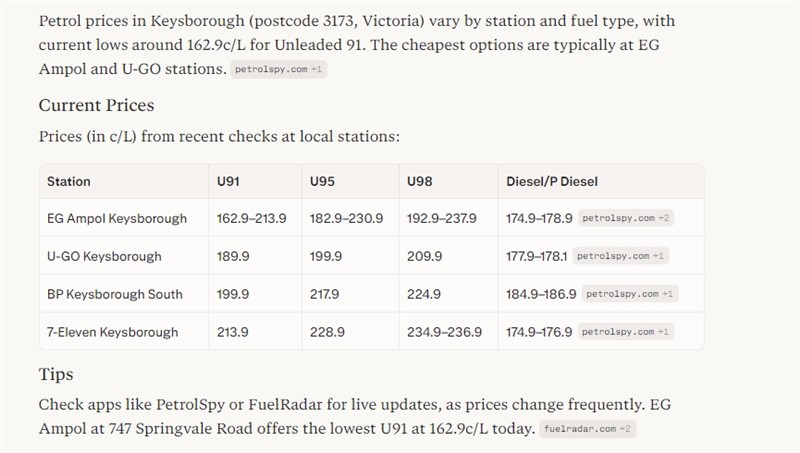
I asked an AI tool for the price of fuel in my suburb, Keysborough, Victoria, today. The AI confidently told me the following:
 \
\
Now sounds like a sweet deal, but it's nonsense; no one will sell me petrol at 162.9c/L today.
I actually decided to drive down Springvale Road and look at a few petrol stations, the cheapest on offer I could find is
U91 at 236.9 c/L
U95 is 249.9 c/L
U98 is 259.9 c/L
Diesel 285.9 c/L
As far as the tip, 747 Springvale Road was not the cheapest and was offering U91 at 249.9/L.
Now, why did the AI get it so wrong? Because it reads an old price on a web page. It didn't plug into the live, real-time computer system at the petrol station. Then what the AI did was stitch together these pages it found on the internet and presented them as today's truth.
Now, the same flaw occurs when you check other retail stock prices in your POS system. Now petrol is a well-advertised product; imagine what it's doing to less-advertised prices like chocolates. There are several problems here. A typical problem is that the AI looks at an old web page showing $7.99 for a special Christmas promotion from three months ago. But that promotion is over, and everyone else is back to selling it for $12.99. The other issue is that, unlike petrol, companies actively block AI bots from reading their live prices online. This means AI can't see what these companies are charging today.
Info: If you unquestioningly trust the AI, you'll slash your prices for no reason. You'll throw away your hard-earned profit.
When Confident Answers Lead You Astray
Now it can be worse as AI is built to sound confident. Developers designed it to be helpful and polite, but not to say "I'm not sure, you should probably check this yourself." It's very hard to argue with AI because it is so emphatic.
How to Use AI Price Look-ups Safely
So, should you ignore AI price look-ups completely? Absolutely not. They're a powerful and exciting tool when used correctly.
You need to treat the AI like a very smart, but slightly inexperienced, junior assistant. You'd never let a brand-new staff member change all your prices without checking their work first. You must treat AI the same way.
Here are four golden rules for using AI retail pricing tools safely.
Rule 1: Use AI as a Guide, Not an Oracle
Treat any price suggested by AI as a second opinion. It's a helpful hint, not the final word. Never rely on an AI tool for live competitor pricing. You may still need to make a trip to see current prices. If the system suggests a price, pause and think about it. Does it feel right for your specific neighbourhood? Does it make sense for your typical customer? You know your local community better than a computer ever will.
Rule 2: Focus on Broad Patterns, Not Exact Numbers
AI is fantastic at spotting big trends. Instead of asking for an exact price, use the AI to look at the bigger picture.
For example, notice if the AI says prices in a certain category are trending upwards. If the software highlights that greeting cards are generally selling for more this year, that's valuable information. You can use that trend to raise your prices across the board gently.
Rule 3: Always Verify Your Own Data First
Before you change a price, you must cross-check the AI suggestion against your own numbers. Look at your current wholesale cost. Look at your minimum required profit margin.
If the AI suggests dropping a price to $10, ask yourself if you still make money at that price. If the answer is no, ignore the AI. Your software holds your true wholesale costs. Always let your true costs dictate your final decision.
Rule 4: Do Your Own Human Scouting
Nothing beats walking into a competitor's shop and looking at their shelves. You should still run a short, periodic scouting routine.
Pop into nearby stores once a month. See how they display their products. Look at their actual price tags. This real-world check keeps your AI tool honest. It gives you a realistic view of what's truly happening on your street.
Info: There is specialised software available for price look-ups; both Google and Bing have a shopping option, Amazon can be useful and has a very sophisticated price look-up system, and there are other specialised price look-up software like PetrolSpy, which I use a lot. Be careful, as they have errors too, but they can give you a guide.
The Final Word
The technology is moving incredibly fast. In the next few years, AI tools will get much smarter. They'll become better at understanding live data. They'll integrate even deeper into the retail software you use every day. Today, however, we can only use what we have.
In summary, AI price look-ups are a brilliant addition to your Point of Sale (POS) system, provided you know their limits. They're fantastic for spotting broad trends, catching pricing mistakes, and saving you from tedious spreadsheet work.
However, they're incredibly dangerous if you treat them as a live data dashboard. Always remember the petrol station trap above.
Written by:

Bernard Zimmermann is the founding director of POS Solutions, a leading point-of-sale system company with 45 years of industry experience, now retired and seeking new opportunities. He consults with various organisations, from small businesses to large retailers and government institutions. Bernard is passionate about helping companies optimise their operations through innovative POS technology and enabling seamless customer experiences through effective software solutions.